• Home
  • About
    • The Gift
    • 100 Days
  • Selected Essays
  • Books
Menu

VALERIE MONROE

Street Address
City, State, Zip
Phone Number

Your Custom Text Here

VALERIE MONROE

  • Home
  • About
  • 100 Days at the Met
    • The Gift
    • 100 Days
  • Selected Essays
  • Books
GreatMoments.jpg

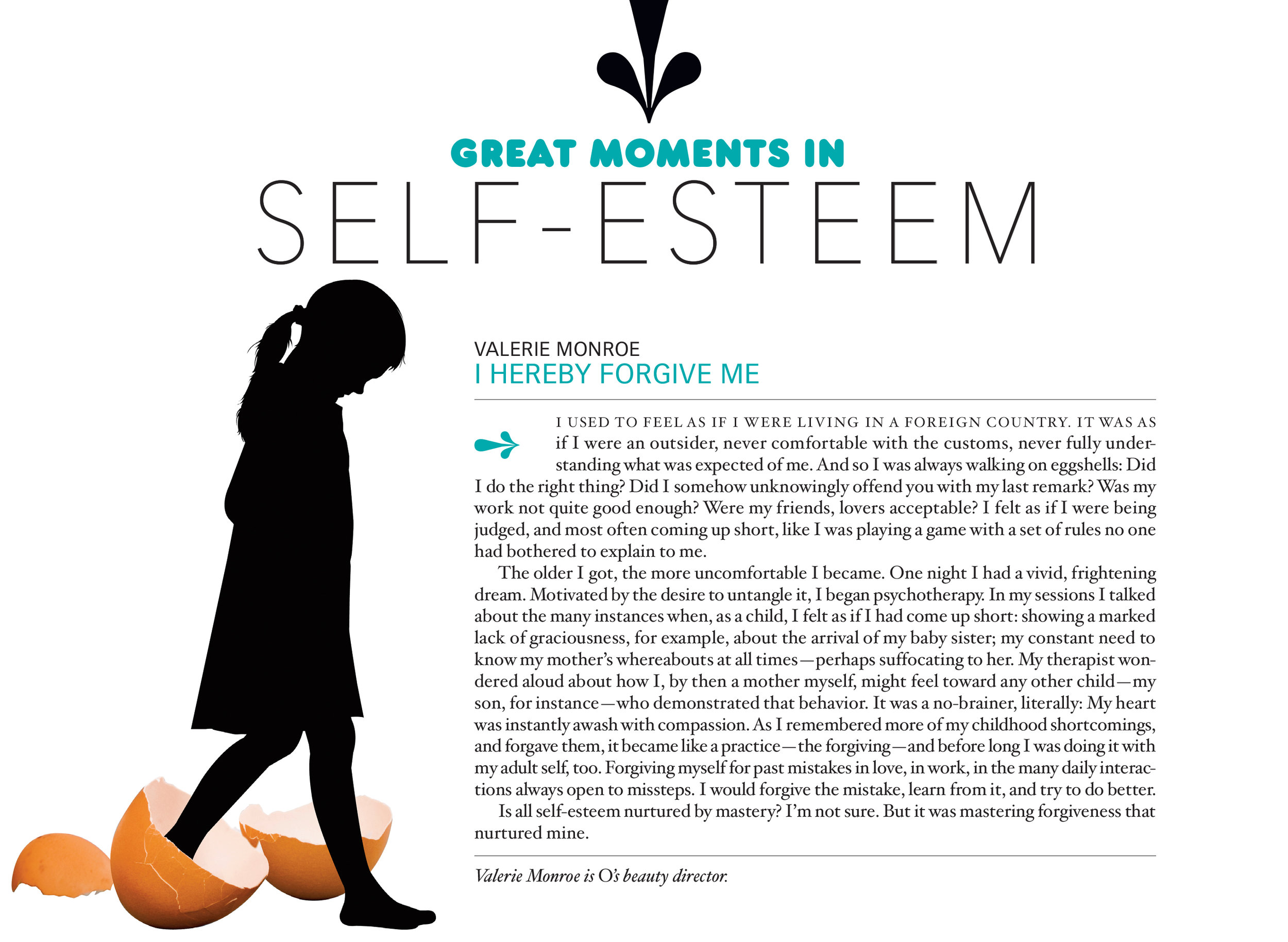
Great Moments In Self-Esteem: I Hereby Forgive Me

I used to feel as if I were living in a foreign country. It was as if I were an outsider, never comfortable with the customs, never fully under-standing what was expected of me. And so I was always walking on eggshells: Did I do the right thing? Did I somehow unknowingly offend you with my last remark? Was my work not quite good enough? Were my friends, lovers acceptable? I felt as if I were being judged, and most often coming up short, like I was playing a game with a set of rules no one had bothered to explain to me.

The older I got, the more uncomfortable I became. One night I had a vivid, frightening dream. Motivated by the desire to untangle it, I began psychotherapy. In my sessions I talked about the many instances when, as a child, I felt as if I had come up short: showing a marked lack of graciousness, for example, about the arrival of my baby sister; my constant need to know my mother’s whereabouts at all times—perhaps suffocating to her. My therapist wondered aloud about how I, by then a mother myself, might feel toward any other child—my son, for instance—who demonstrated that behavior. It was a no-brainer, literally: My heart was instantly awash with compassion. As I remembered more of my childhood shortcomings, and forgave them, it became like a practice—the forgiving—and before long I was doing it with my adult self, too. Forgiving myself for past mistakes in love, in work, in the many daily interactions always open to missteps. I would forgive the mistake, learn from it, and try to do better.

Is all self-esteem nurtured by mastery? I’m not sure. But it was mastering forgiveness that nurtured mine.

Great Moments In Self-Esteem: I Hereby Forgive Me

I used to feel as if I were living in a foreign country. It was as if I were an outsider, never comfortable with the customs, never fully under-standing what was expected of me. And so I was always walking on eggshells: Did I do the right thing? Did I somehow unknowingly offend you with my last remark? Was my work not quite good enough? Were my friends, lovers acceptable? I felt as if I were being judged, and most often coming up short, like I was playing a game with a set of rules no one had bothered to explain to me.

The older I got, the more uncomfortable I became. One night I had a vivid, frightening dream. Motivated by the desire to untangle it, I began psychotherapy. In my sessions I talked about the many instances when, as a child, I felt as if I had come up short: showing a marked lack of graciousness, for example, about the arrival of my baby sister; my constant need to know my mother’s whereabouts at all times—perhaps suffocating to her. My therapist wondered aloud about how I, by then a mother myself, might feel toward any other child—my son, for instance—who demonstrated that behavior. It was a no-brainer, literally: My heart was instantly awash with compassion. As I remembered more of my childhood shortcomings, and forgave them, it became like a practice—the forgiving—and before long I was doing it with my adult self, too. Forgiving myself for past mistakes in love, in work, in the many daily interactions always open to missteps. I would forgive the mistake, learn from it, and try to do better.

Is all self-esteem nurtured by mastery? I’m not sure. But it was mastering forgiveness that nurtured mine.

Summary Block
This block is invalid. Please check the block settings and try again.
Featured
Aenean eu leo Quam